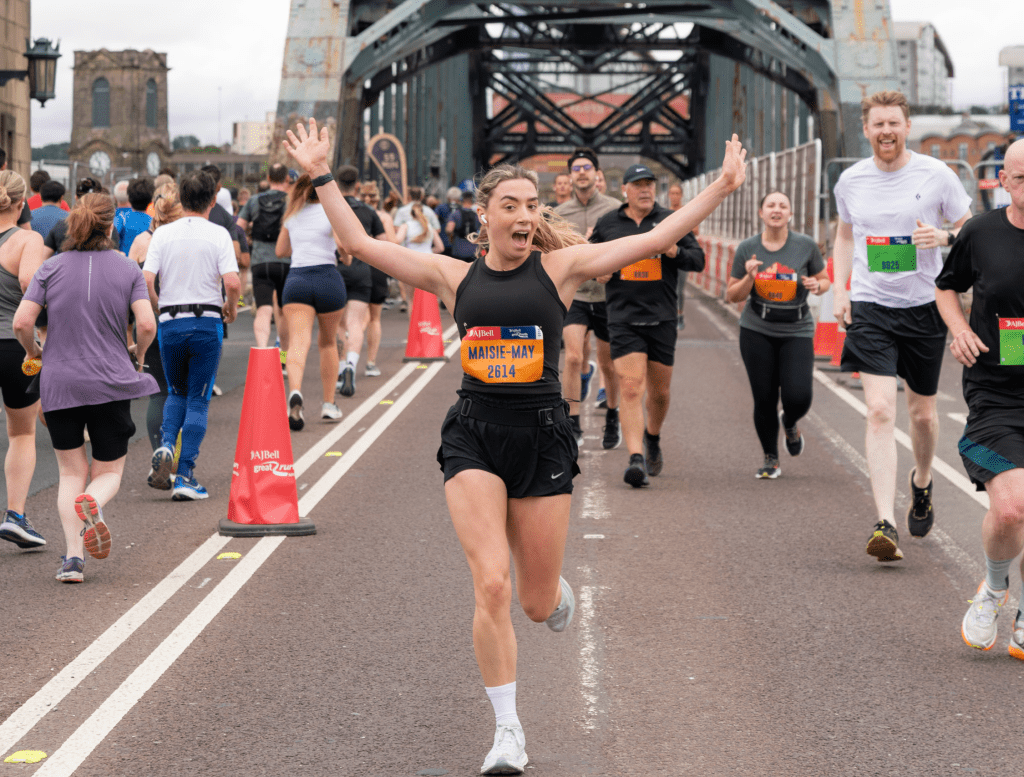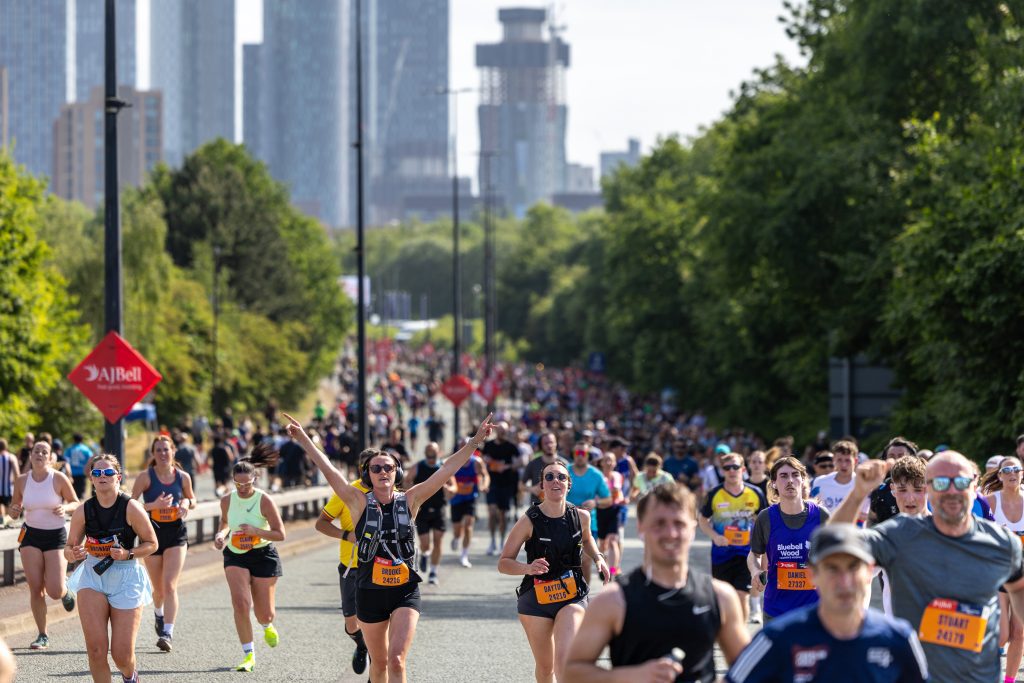

The humble 10k – loved by runners the world over.
Both challenging and accessible, it’s a massive milestone to sign up for your first 10k event. And for more experienced runners, it’s a good gauge of how your running’s going.
Plenty of seasoned athletes aim to stay 10k-ready, or use an upcoming event to give them something to aim for. After all, a shiny new PB is always tempting…
But if you’re thinking of taking the plunge, you might be wondering how long it takes to run a 10k. The answer depends on several factors, including (unsurprisingly) your experience, fitness level and training.
Looking for a comprehensive guide to understanding finish times, setting realistic goals and improving your performance? You’re in the right place – read on.
Why is it a 10k so popular?
Attention, all imperial fans: a 10 kilometre run is equivalent to 6.2 miles. For running newbies, that *might* sound like a long way. But once you start training, you’ll soon realise just how doable it is.
Once weekly runs turn into two or three (or four!) outings a week and your mindset shifts from ‘This is torture!’ to ‘I think I’m enjoying this?’ you might find yourself tempted to take part in an organised running event.
After all, an organised event makes you more accountable. You’ve paid your money, you’ve joined the Strava group and you’re liking strangers’ training selfies on Instagram.
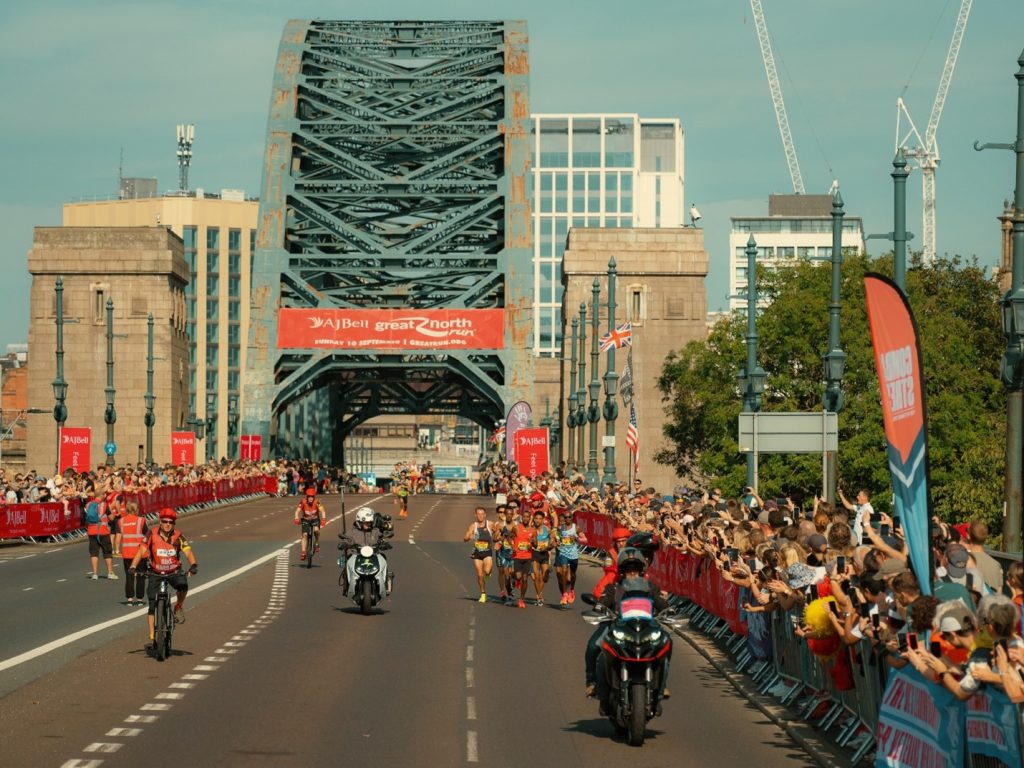
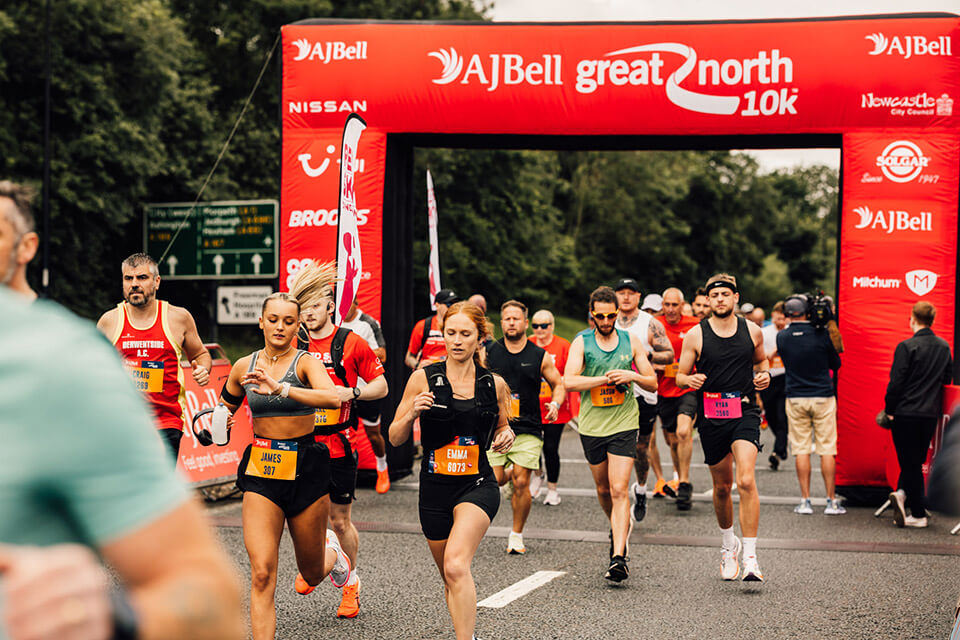
Plus, at bigger events like the Great North 10K, there’s often a stunning route, live music, entertainment and a shiny medal-shaped reward to motivate you.
Average 10K finish times by runner type
- First up, beginner runners.
The typical finish time range for beginner runners can range anywhere from around 60 to 75 minutes – or beyond. But that’s just an average.
Remember: everyone’s goals are different and pacing yourself and/or walking breaks are totally allowed. Plus, your first organised event should be all about the *experience*.
- Intermediate runners
The average time for an intermediate runner to complete a 10k typically ranges from 50-60 minutes.
If you’ve got some 10K experience and are looking to improve on your finish time, an intermediate training plan will help (psst: we have some here.)
You’ll need to focus on your pacing, too – as a starting point, if you want to complete a 10k in 59 minutes, you’d need to run 9 and a half minute miles (or 5:54 minute kilometres).
- Advanced runners
Aiming to finish your 10k in 40-50 minutes – or perhaps even less? Congratulations – you’re an advanced runner.
But you already knew that – right? Chances are you’re a club member, always in training, and a pace of 6:26 per mile (or four minutes per kilometre) doesn’t sound impossible.
- Elites
Until recently, the British Men’s 10k record was held by Mo Farah, British and Great North Run legend. However, in January 2025, British runner Rory Leonard set a new record of 27 minutes 28 seconds at a road race in Valencia.
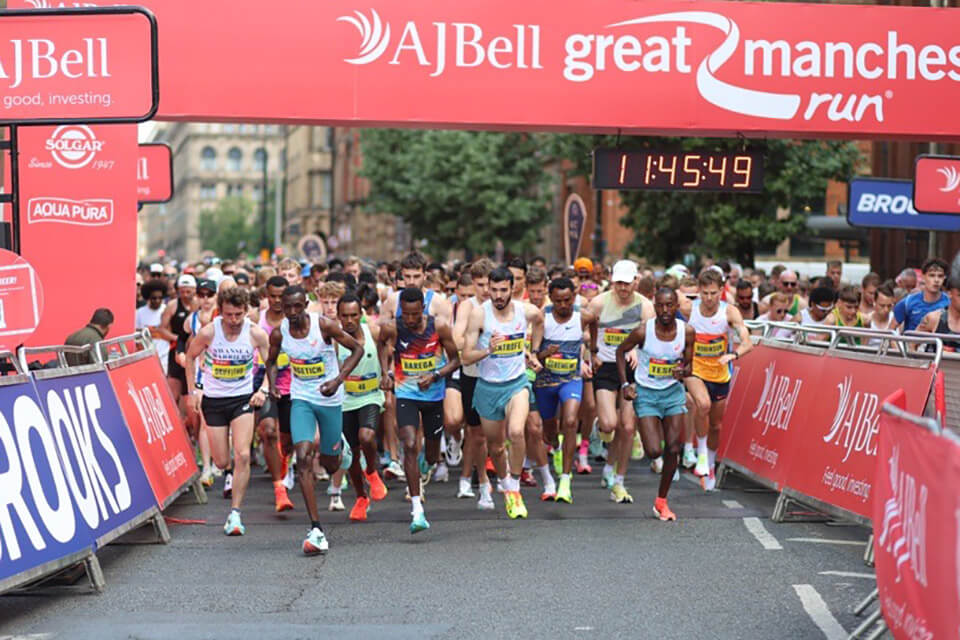
The fastest 10k time at the 2025 Great Manchester Run 10k was Elite Men’s winner Selemon Barega (Ethiopia) who completed the course in 27:49.
Remember, though, these runners are the best of the very best. Be inspired, rather than intimidated.
Average 10K finish times by age and gender
Two other factors to take into account when talking about average finish times are age and gender.
Generally speaking, men’s 10k finish times range from 45-60 minutes, whereas women’s fall between 50-70 minutes. Again, these are averages.
And while younger runners may record faster times on average, lots of athletes bitten by the running bug go on to improve into their 40s, 50s or 60s. Training – and consistency – is key for making running a rewarding activity at every stage of life.
We talk a lot about ‘averages’ in running, but averages only exist when you compare runners against each other. For most people, the only runner who really counts is *you* and the personal progress you’re making.
How to predict your 10K finish time
Use a pace calculator
If you’ve got a goal in mind, you’ll need to work out the pace required to get there. Enter your new best friend: a pace calculator.
Simply enter your goal and distance, and the calculator will generate pace times – usually in both miles and kilometres – plus split times, which make it easier to track whether or not you’re on progress.
It’s not an exact science, of course – a pace calculator doesn’t know what you’ve had for breakfast or if you’re fighting against the wind. But nevertheless, it’s a helpful tool in smashing your running goals.
If you’re signed up to Strava, you can make use of their free pace calculator. And Runna also has one available which doesn’t (currently) require a sign-in.
Estimate based on a recent 5K time
Alternatively, you can take a recent 5K time and apply a formula tested by runner and statistician Andrew Vickers to work out an accurate 10K time.
Instead of multiplying by two – double the distance – which might seem logical, he tested multiplying real-world race data by 2.085, otherwise known as the Riegel formula. The extra 0.085 allows for fatigue over a longer distance – and the results were pretty accurate.
So, as an example, if you’ve recently run a 5K in 28 minutes, multiply it by 2.085 to get a more precise 10K time.
28 x 2.085 = 58.38 (but remember the 0.38 isn’t 38 seconds, but rather 0.38 of a minute, or 22.8 seconds).
Use a pace chart to set goals
You can also use a pace chart to help you set goals for your 10k. These will tell you the pace you need to average across the whole 10K distance to achieve your goal time.
There are lots available online, but again, the key word is average.
If you want to hit 55 minutes, the pace chart will tell you that you need to average a pace of 8 minutes 51 seconds per mile (or 5:30 per kilometre). In reality, that probably means going faster at the beginning of your event (or on the flats/downhills) and slower towards the end or on the uphills to allow for fatigue and increased challenge.
How long does it take to train for a 10K?
- For beginners, allowing at least 8 weeks for training will allow you to build confidence and increase your weekly longer run by 0.5-1 mile per week. If it takes longer, that’s OK too – if you’re starting from zero, giving yourself 12 weeks will give you time to build up from run/walk intervals, increase your endurance and sense of self-belief.
- For intermediate and advanced runners, 4-6 weeks of training should be enough to get you 10K ready (although 8 weeks will yield even better results). You should be aiming for 4-5 runs per week, and building tempo runs and intervals into your training programme (did we mention we have plenty available here?)
But whatever your level or goals, remember to REST (essential for recovery), add in some cross/strength training (tips here) and, above all, listen to your body. Pushing on through pain is a shortcut to injury – don’t dash your 10K dreams before they’ve started.

Training tips to improve your 10K time
These tips work for all runners, whatever your ability. They’ll help you stay consistent and boost your performance to new heights.
- Focus on consistent weekly mileage
Yes, it sounds like something your mum would say, but consistency really is key when it comes to 10K training. Steady effort beats short bursts of intense effort every time. It’ll make your regime more sustainable, build stamina slowly and help you avoid injury.
- Include speed workouts (intervals & tempo runs)
If you’ve got a goal in mind, speed workouts are an important part of your training. Try mixing up high-intensity and recovery running, perhaps applying the 80:20 effort ratio or use the one minute rule (one minute of fast running, followed by a minute’s recovery. Repeat x10. At your next speed session, increase the fast running period to two minutes).
You could also try reps of 10 x 400m / 6 x 200m / 4 x 100m. Find a nice, flat stretch, take a minute’s recovery time in between reps and two minutes between distances. Try to increase your pace as the distances get shorter. You’ll feel supercharged in no time.
- Long runs once a week
Weekly long runs are the staple of any training plan – this is where physical conditioning and mindset work really happens.
Each week, try adding 0.5-1mile (or 1-2km) to your long run distance, and your longest run should be 10k (or slightly shorter).
- Strength training for runners
Focusing on your core, glutes, hamstrings, quads, and calves in weekly strength training sessions will help you build stability and power, as well as avoid niggly pains and overuse injuries.
Simple bodyweight exercises like squats, lunges, planks, glute bridges and calf raises can help transform your run from good to great. Too easy? Add in resistance bands or weights if you fancy an added challenge.
- Track your progress with apps or journals
Using a running journal – either on paper or a digital log – can be a brilliant way to track your progress and stay accountable. Record your distance, time, how you felt, and any challenges. Adding in details like the weather, terrain, and what you ate beforehand can also help you spot patterns and identify your best running practice.
Apps like Strava and Garmin allow users to record their runs and highlight your achievements, and you can get a good level of functionality without paying for a subscription.
10K nutrition and recovery essentials
Fueling right for your 10K training is a game-changer.
Before training runs, try to eat a light snack with some carbs and a little protein – think banana with peanut butter or some wholemeal toast. After runs, refuel with protein and carbs to help muscles recover – a smoothie maybe, or eggs on toast are great. Staying hydrated is also crucial, and not just during your runs – it’s important to get enough water before and afterwards, too.
And don’t forget rest days and sleep – this is when your body rebuilds stronger. Treat recovery like part of training and you’ll feel like a 10K superhero in no time.
Race Day Strategies to Run Your Best 10K
- Tapering before the race
Cutting back on distance 7-10 days before the race lets your legs recharge. You won’t lose fitness – just gain freshness! Think of it as a mini spa break for your muscles so they’re ready to fly on race day.
- Race pacing tips
Pacing is key to a strong 10K. Don’t start out too fast – it’s the most common mistake made by 10K newbies. Instead, start steady, find your rhythm, and aim for even splits or even a slight negative split (i.e. finishing faster than you started).
Another useful tip is splitting the race into three sections – your first 3k (strong and steady), 4-7k (pick up the pace slowly to your target race pace) and then 7k to the finish line (dig deep and go for it!)
- Mental strategies for staying strong during the race
It’s not just about physical training – your mental game matters, too.
Top tips: dividing the distance ahead into chunks doesn’t just help your pacing; it also helps your mindset. And small goals can help keep you motivated, like making it to the next water station, catching up to the runner ahead or focusing 100% on your form for one minute.
Mental cues or mantras can also keep your confidence high and stop negative thoughts creeping in. Try repeating short motivational phrases like ‘strong and steady’ or ‘one step at a time.’ Counting your breaths or footfalls can also help you focus and calm any nerves.
Finally, soak up the support and race day atmosphere – you’ve trained for this, and you deserve to smash it!
Choosing the right running gear
You don’t need fancy kit to run a 10k, but quality, well-fitting trainers are an absolute essential. Our best advice is to head to a specialist running shop and have your gait assessed – that way, you’ll end up with shoes which match your foot plant, stride and running pattern. Just make sure you break them in well before the big day – new shoes on race day is a recipe for disaster (and blisters).
Clothing-wise, choose lightweight clothing and – just as with your trainers – don’t wear anything new on race day in case it starts to chafe halfway round. A running belt is a good idea for carrying your essentials, e.g. phone, keys and cash. And a running watch is by no means essential, but a ‘nice to have’ if you’re keen to track your progress and hit your goals.
Find your next Great Run
You’ve got all the advice – now all you need is an event.
Great Run Series events include 10Ks up and down the UK, including the Great North 10K in Newcastle and other locations including Birmingham, Manchester, Bristol and Glasgow.
As with all Great Run Series events, our 10Ks are fun, friendly and unforgettable, with incredible atmospheres, stunning routes and top-notch organisation. Search here or sign up to our newsletter here to make sure you never miss an early bird offer.
Quick FAQs – Common questions about running a 10K
- How long should I train before my first 10K?
Beginner? 8-12 weeks, depending on whether you’re starting from zero or already have a little running experience. Intermediate or advanced runners? 4-8 weeks – again, depending on your experience and goals. Check out our training plans and advice.
- Can I walk during a 10K race?
For 10K first-timers in particular, it’s important not to get hung up on running the whole way. If walking breaks allow you to enjoy the experience, go for it. Inclusive events (like Great Run 10Ks) welcome walkers with open arms!
- What should I eat before running a 10K?
You can’t go wrong with a nutritious carb-and-protein based breakfast – porridge with a dollop of Greek yoghurt, for example, or eggs on wholemeal toast. Don’t eat anything new or adventurous on race day – stick to tried and tested, familiar food.
- Can I run a 10K without any training?
Two words: please don’t. We’d really hate you to hurt yourself, and taking on a 10K challenge without training is a big no-no.
- Is 10K a good distance for fitness or weight loss?
It’s great for both. If you’re aiming for (sustainable, healthy) weight loss, running burns anywhere between 600 and 1000 calories per hour. Training for a 10K will also help build your cardiovascular fitness, lower your heart rate and blood pressure and improve muscle tone.
- What 10K run events are there in the UK?
We’re glad you asked. Take a look at our 10k events, including the AJ Bell Great Manchester Run and the AJ Bell Great North 10k. Electric atmosphere, superb support and an unforgettable race day experience guaranteed!